The US Civil War was a horrible, brutal war. Men raised their weapons against their countrymen, and they slaughtered one another in one of the most violent and devastating conflicts in US history. By the end, 625,000 people had died—more American casualties than World War I and World War II combined.
Nobody imagined that it would be so devastating. When the war began, many thought it would be over in the blink of an eye. Some treated it like a game or a spectator sport. There are some little-known stories that show what people thought this war was going to be, and how the dark truth of what was really happening set in. Featured image credit: 37thtexas.org
1#Congress Got In A Drunken Fistfigh
In 1858, the US Capitol gave the world an early preview of the war to come. Congress was debating the statehood of Kansas. Their proposed constitution permitted slavery and forbade free blacks from living in the state.
The Northern Republicans were furious. Congress spent days arguing about it. As the debate went on, extending past midnight, they started drinking heavily just to keep from falling asleep.
It was 1:30 AM when Laurence Keitt, a Democrat who was drunk out of his mind, stood up, pointed in Republican Galusha Grow’s face, and slurred out, “You’re a black Republican puppy!” Grow snapped back, “No Negro driver shall crack his whip over me!” Lunging at Grow, Keitt yelled that he was going to choke Grow, and the whole building erupted into a vicious brawl.
There was an effort to calm it down. The Speaker of the House tried banging the house mace, but it only made things worse. Another congressman, misunderstanding what the Speaker was trying to do, thought this meant that weapons were fair game. The congressman grabbed a metal spittoon and smashed it into someone’s head.
The fight didn’t stop until someone grabbed William Barksdale in a headlock and started punching him in the skull. Barksdale broke free, but his hairpiece didn’t come with him. Embarrassed, he picked it off the ground and put the wig on his head backward.
The politicians burst into laughter, and everyone finally calmed down. The fighting stopped, and they managed to come to an agreement—pacified by a man’s wig.
2#An Audience Came Out To Watch One Of The First Battles
Soon, war broke out. On July 2, 1861, 30,000 Union soldiers marched to Centreville, Virginia, waiting to fight the First Battle of Bull Run (also known by the Confederate soldiers as the Battle of First Manassas).
The battle was only a few miles from Washington, DC, and for the people there, it sounded like a good show. This was still in the early days of the war, and they were sure that the Union would have a quick, bloodless victory. A lot of civilians figured there’d be no harm in going out to watch the war.
As dawn broke, a caravan of carriages and wagons made their way to the battlefield, where they set themselves on the side of a ridge to watch. One woman even brought opera glasses. As the battle began, she peered through her glasses for a good view of the fighting, letting out delighted little cries of “That is splendid!” and “Oh my! Is that not first-rate?”
Having an audience got people excited. A few soldiers walked over to the spectators and gave a running commentary on everything that was happening. Meanwhile, a few civilians became so worked up that they tried to sneak onto the battlefield.
Soon, though, it became clear that the Confederates were winning. A cavalry charge overran some civilians who had gotten too close. Some ended up as prisoners, and others didn’t make it out alive. As panic broke out, the audience had to flee and escape back to the capital.
3#The King Of Siam Offered War Elephants To Lincoln
Before the war, King Rama IV of Siam found out that the US did not have elephants. This, King Rama IV felt, was a tragedy and one that needed to be righted as soon as possible.
When the Civil War began, Rama IV jumped on the opportunity. He wrote to Abraham Lincoln, offering to send him as many war elephants as he required. These, King Rama IV explained, would not only help him crush the Confederates but could also be put to work on construction projects or just set loose in the forests.
Lincoln did his best to be polite. “I appreciate most highly Your Majesty’s tender of good offices,” he wrote back. “Our political jurisdiction, however, does not reach a latitude so low as to favor the multiplication of the elephant.”
It’s easy to imagine, though, that a few years further in, Lincoln was probably regretting not putting a few war elephants on the front lines.
4#The Union Was Obsessed With Coffee
For the Union, coffee was a big deal. In fact, the word “coffee” shows up in Union letters and diaries more often than any other word—including words like “war,” “bullet,” “Lincoln,” and “mother.”
Coffee was a more regular part of soldier life than fighting. Every soldier was given a ration of 16 kilograms (36 lb) of coffee per year, and they drank it every morning. One rifle company even made a rifle that had a coffee grinder in the stock. Since most troops only fought two weeks per year, the coffee grinder ended up being used more than the bullets.
The Confederates, on the other hand, hardly had any coffee. Union blockades kept the Confederates from getting their daily caffeine fix. Some Confederate soldiers were so desperate for a java fix that they would brew potatoes and rye until they turned black, just to have a caffeine-free, bitter drink that the soldiers could pretend was coffee.
Caffeine actually made a strategic difference in the war. One Union general would time his attacks based on when his men were most buzzed on caffeine, convinced that the extra rush from coffee gave his men a fighting advantage.
5#One Of The Main Causes Of Death Was Diarrhea
The men might have spent most of their time waiting instead of fighting, but that didn’t mean they were safe. The biggest threat in the Civil War wasn’t the enemy—it was disease. The squalid, unsanitary conditions of war let illnesses run wild. By the end, sickness had killed nearly twice as many men as bullets.
The biggest killer was diarrhea, especially from dysentery. Nearly as many men died in a fit of diarrhea as in combat. It was such a major problem that they set a code of battle: If any man was “attending to the imperative calls of nature,” it was forbidden to shoot.
An expression still used today came from this: “You have to have good guts to be a soldier.” When the Civil War soldiers first started saying it, they weren’t talking about bravery. In this war, anyone who couldn’t hold off diarrhea would have a short life.
6#A Battle Stopped To Watch A Fistfight
During a battle at Saunders Field, the Union and Confederate forces stopped shooting to watch two men duke it out.
The Union forces had opened fire on the Confederates, and in a panic, one of the men jumped into a gully for cover. When he got inside, though, he realized that he wasn’t alone. A Union soldier was already hiding inside, and now two men on opposite sides were cowering in a hole together.
The men started bickering. Each one was pretty sure that he had captured the other, but neither could agree on who had captured whom. So they decided to settle it the old-fashioned way. They would have—in their words—“a regular fist and skull fight.”
The sight of two soldiers climbing out of a gully and beating each other in the head was so baffling that both armies stopped shooting. For a moment, both sides just watched as the men beat the hell out of each other.
The Confederate soldier knocked down the Union soldier. He gave in, and the two men, agreeing on the winner, went back into hiding. As soon as they did, the war started up once more. The two men hid in the gully together until the battle was over. Then, true to his word, the Union soldier presented himself as a prisoner.
7#People Bought Tickets To Watch Prisoners Of War
One of the most brutal prison camps in the war was Elmira Prison. It had been built to hold 5,000 Confederate soldiers. But as the war raged on and more people came in, the prison started getting more than it could handle. Soon, there were nearly 10,000 people crammed inside its walls.
The civilians couldn’t help but be a little curious, and it didn’t take long for someone to capitalize on it. A tower was set up across the street. For 15 cents, you could climb to the top, take a seat with some peanuts and lemonade, and watch the prisoners.
The prisoners started to realize they were being watched and, being bored out of their minds, began putting on shows to make it worthwhile. Some would juggle or do acrobatics to impress the audience watching them from above.
The guards put a stop to their antics, though. Soon, there was nothing to do but wither away. Disease spread through Elmira so viciously that a quarter of the prisoners died. But the audiences kept coming out, paying a nickel and a dime to watch men waste away and die.
8#Thousands Of Soldiers Held Massive Snowball Fights
One morning in 1864, the Confederate Army woke up to 13 centimeters (5 in) of snow. The men rushed out and fought what may be one of the biggest snowball fights in history.
Up to 20,000 men were involved. The Tennessee and Georgian soldiers divided themselves into two armies, built up arsenals of snowballs, and charged at each other. On Tennessee’s side, Colonel Gordon even rode out on horseback, holding up a dirty handkerchief like it was a flag and pelting his men with snow.
Other fights broke out among the Confederate forces. Men lined up, using all their military training, and launched volleys of snowballs at the other side. Some who ran too close to the enemy line were dragged over to have their shirts stuffed with snow.
The boys, after all, were young—some only 17 years old. When the snow cleared, they picked up their weapons again and marched for another battle, where more than just a shirt full of snow awaited.
9#Southern Children Were Told That A Yankee Had Shot Santa Claus
By 1863, the Union blockades had made life in the South insufferable. Prices were skyrocketing, and it was a struggle for families to afford food. As Christmas came around, parents were faced with the harsh reality that they would not be able to get anything for their children.
They had to come up with an explanation, and some of them were pretty harsh. Some parents told their kids that Santa Claus wasn’t coming because he had been shot by Yankee soldiers.
Other parents were a bit gentler, of course. Many told their kids that Santa couldn’t make it through the Union blockade. It affected the kids. In her memoir, one woman wrote that, as a little girl during the Civil War, she would spend her time staring at maps, trying to find a path that Santa Claus could use to break through.
10#An Entire University Signed Up And Didn’t Come Home
When the Civil War began, the University of Mississippi had 139 students. Of them, 135 signed up to fight for the Confederate Army. The school was put to use as a war hospital, and all but four members of its student body joined together to form Company A of the 11th Mississippi.
Not a single member of the company, nicknamed the “University Greys,” made it back unharmed. They group had a rare 100 percent casualty rate, with every man either coming back wounded or never making it home at all.
The Greys were even supposed to fight in First Battle of Bull Run. Their train, however, was delayed, and most of the men didn’t make it. Even without fighting, though, Colonel Moore became one of their first casualties by accidentally shooting himself in the foot.
The rest of the group kept fighting and nearly made it to the end. But on the last day of the Battle of Gettysburg, the Greys joined a mad, desperate charge against the Union soldiers. Of the Confederate soldiers involved, half died—and not a single man from the University of Mississippi made it out alive.a
Anyone who has ever taken an English class or left a comment on a Web page knows the annoyance of having their grammar corrected. It’s an unpleasant experience for sure, but it turns out those grammar Nazis may be on to something. No, the world won’t come to a screeching halt if a kitten video commenter forgets an apostrophe, but every so often, a situation arises in which proper spelling and grammar are everything. For one brief moment, the fate of a reputation, a company, or even an entire nation can rest on one properly structured sentence. Unfortunately, we rarely know when we’ve encountered such moments until we’re cleaning up the aftermath. Take the following grammatical gaffes as proof that sometimes, proofreading really does matter.
1#South Africa ‘Honors’ FIFA President
After FIFA president Joseph “Sepp” Blatter awarded South Africa the honor of hosting the 2010 World Cup, they decided to return the favor. The South African government bestowed an award known as the “Order of the Companions of O R Tambo” to Blatter for his kindness. However, when they announced that they were honoring him with the award, the world erupted into giggles rather than applause.
Apparently, Blatter’s leadership style had earned him a few enemies of the passive-aggressive kind. At some point, Internet vandals had taken to Wikipedia to take a few artistic liberties with his page. Then, with surprisingly little information about the man they were honoring, officials copied and pasted his name directly from the site for use on the award. That’s how the South African government ended up bestowing a prestigious award to Joseph “Sepp” Bellend Blatter. “Bellend” is a slang term for “penis” in many parts of the world and is most definitely not the FIFA president’s middle name.
2#Obama’s Ironically Error-Prone Communication Advisor
Social media is a blessing and a curse. Sure, people are now connected in ways that our grandparents would have found completely unimaginable, but that also means that every single thing we do has the potential to be seen by millions—including cringeworthy typos.
On October 8, 2013, President Obama’s senior advisor for strategy and communications, Dan Pfeiffer, was discussing politics with a few of his Twitter followers. After a few tweets back and forth about political polarization, Pfeiffer intended to respond with “also a much bigger factor on the right.” Unfortunately, his errant finger found not the “b” key, but its neighbor “n,” as he spelled “bigger.” He didn’t catch the blunder until after he’d sent it to his many followers, but he was quick to point out that it was “obviously a horrendous typo.” Still, it’s not the brightest moment in the career of the communications advisor to the first black US president.
3#Faulty Print Spacing Creates A New Word
If you have ever attended school and/or speak English, you’re probably familiar with Webster’s Dictionary. This behemoth of a book has been around in some form for centuries, and when it comes to writing, we literally take its word. Many take for granted that a word is only “real” if it’s in the dictionary, but the story of one bizarre little noun may shake that faith.
“Dord,” first published in Webster’s New International Dictionary (second edition) in 1934, is a scientific noun meaning “density.” Or at least, that’s what the folks at Webster’s would have had people believe. It turns out that during the research phase, a small index card marked “D or d, cont/ density.” was mishandled and misunderstood by pretty much everyone involved. The elaborate system meant to mark this as an abbreviation for “density” failed spectacularly, especially when it came to print spacing. In the end, “D or d” was crammed together and lumped in with the dictionary’s actual words. It was a nugget of utter nonsense in an otherwise respected book, and it stayed there for the better part of a decade before anyone noticed.
4#Japanese Executives Accidentally Give Away Their Own Company
The world of stock trading is admittedly confusing. There are a lot of numbers flying around, people buying and selling, and fortunes being won and lost. In other words, it is the kind of place where you want to quadruple-check every single thing you write. Unfortunately, Japanese firm Mizuho Securities had to learn that the hard way.
When going public with their new company J-Com Co. on December 15, 2005, Mizuho executives intended to sell each share for 610,000 yen. However, due to a potentially suicide-inducing typo, they accidentally sold 610,000 shares (41 times what they actually had) for 1 yen each. Realizing their error, they tried to cancel several times but were basically told that in the stock exchange, “all sales were final.” So they were forced to sit and watch as they gave away their brand-new company, and then some, for pocket change. To add insult to injury, they had to pay customers for the nonexistent extra shares, an amount totaling $225 million.
5# Misplaced Decimal Ruins Dinnertime For Decades
Everyone knows how incredibly healthy spinach is. From the moment we’re born, we have our parents, teachers, and doctors telling us that it’s a miracle food. Popeye, one of the most recognizable animated faces in the world, uses it to give himself full-on superpowers. Our society very nearly worships the leafy green vegetable.
But it’s a fraud, an ordinary food wearing an ultra-healthy mask. The misconception that spinach is the holiest of the vegetables comes to us from German chemist Erich von Wolf. In 1870, Wolf was researching the nutritional benefits of different foods, including spinach. While testing for iron content, he mistakenly placed the decimal point for spinach one spot too far to the right. This meant that the vegetable’s humble 3.5 grams was inflated to a staggering 35 grams.
Wolf’s fumble was taken as fact until 1937, when the mistake was discovered, and attempts were made to correct public opinion. But by then, the popularity of spinach-munching Popeye had solidified the vegetable’s undeserved reputation, and the rest is dinner-destroying history.
6#Vatican Misspells ‘Jesus’ . . . 6,200 Times
In 2013, the Vatican wanted to commemorate the beginning of Pope Francis’s papacy with a big, bold gesture. So, they commissioned a series of gold, silver, and bronze medals from the Italian Mint. These small tokens featured an image of Jesus with a Latin phrase that the new Pope found particularly inspirational. They were sold at the Vatican Publishing House in St Peter’s Square . . . for about five minutes.
It seems that a few people were asleep at the switch at the Italian Mint. Despite the many bizarre words in the medals’ incredibly complex Latin phrase, the only one that tripped them up was “Jesus.” Thousands of holy tokens rolled off the line with Christianity’s most revered figure’s name spelled “Lesus.” Even more bizarre is the fact that almost no one at the Vatican noticed. They went on sale with the glaring typo on full display, and four were purchased before the batch was yanked. Those four are now predicted to explode in value.
7#Google Accidentally Shuts Down the Internet
Google is pretty great; it connects us to the billions of Web pages out there quickly and efficiently and protects us from the malicious ones. That level of security is one of the reasons that Google is the mega-service it is, but it still isn’t perfect. Sometimes, the work required to police the flood of new content on the Internet means that programmer attention is spread just a little too thin.
Case in point—the morning of January 31, 2009. While updating the list of harmful sites, one Google employee accidentally listed “/” as a malicious site, which would be blocked by Google. If you have any experience online whatsoever, you will realize that pretty much every web address in existence contains a slash. What that means is that for about an hour, the entire Internet came to a screeching halt as Google prevented access to every single website. Visitors were turned away with a warning screen—and a complete block page if they continued anyway. Google soon corrected the issue, but for one brief moment, communication was set back decades.
8# Poorly Written Manual Fries People With Radiation
When it comes to advanced medical equipment, the last thing you want is a failure to communicate. Some of the contraptions we dream up to heal the sick can, if used improperly, make them much sicker. That includes contraptions like, say, a giant radiation gun.
The Therac-25 was a device from the 1980s that was designed to treat cancer patients with controlled bursts of radiation. Radiation is obviously extremely dangerous, so the machine came with a program to keep exposure strictly limited. This program came with a manual to ensure that the operator knew how to handle any issues.
But unfortunately, said manual was apparently written by someone with no knowledge of how communication works. The nonsensical word salad was completely confusing to doctors, so they more or less ignored it. When error messages popped up on the Therac-25, they just did what they thought was best. They ended up blasting patients with up to 100 times more radiation than is considered safe. Three died, leaving us with a sobering tale about the importance of writing skills.
9#Garbled Computer Code Darkens The East Coast
Life in a computer-controlled society is a double-edged sword. Sure, things are a lot easier with machines handling the monotony, but giving them too much responsibility can be devastating. All it takes is one typo in a computer’s millions of lines of code to completely cripple whatever system it’s handling.
And on August 14, 2003, that system happened to be the North American East Coast’s power grid. A misplaced character buried deep in an Ohio power plant’s XA-21 energy management system began a cascade of glitches that rippled across the Northeast US and into Canada. Within hours, other power stations were failing, and entire cities were going dark, including New York City. In the end, over 50 million people were left without power, communication, and infrastructure for roughly seven hours.
To make matters worse, the whole thing could have been avoided if one power plant employee hadn’t turned off an alarm. When the initial glitch appeared, the error alarm was disabled while it was “fixed.” The alarm was never turned back on, meaning when the bug acted up again, it remained hidden until it was far too late.
10#NASA’s $80 Million Hyphen
When someone wants to call something simple, they usually say something like, “Well, it isn’t rocket science.” There’s a reason for that: Rocket science is extremely complicated. There are a lot of complex calculations to be done and a million disasters just waiting to happen. Something as harmless as a symbol in an equation can wreck everything.
This is exactly what happened on July 22, 1962. The Mariner 1 space probe had just launched from Cape Canaveral for its journey to Venus. Shortly after liftoff, however, it became clear that something was wrong. The rocket carrying the probe began to veer off course, putting it into a path that would carry it not only to a crash landing, but one in a populated area. With no other choice, NASA officials sent a self-destruct signal, destroying the probe and spreading debris across several states.
So what went wrong? While coding the spacecraft’s guidance system, an inattentive programmer forgot something: a hyphen. A single missing “-” caused an $80 million dollar space project to literally go up in flames before it ever even left the atmosphere.
It is arguably the greatest drama of all time. It is #peakTV at its finest. Breaking Bad will go down in history as one of the most influential shows of all time. Many people call the show perfect. In fact, Sir Anthony Hopkins, one of the greatest actors of all time, told Bryan Cranston “Your performance as Walter White was the best acting I have seen—ever.” High praise from a legend. But, what about the facts regarding the show we never hear about? Well, here are ten facts about Breaking Bad to die for.
1#The Blue Dye is Real!
Ever since Breaking Bad‘s monumental success, actual meth dealers started adding blue dye to their crystal meth in an effort to increase sales. The idea was to “brand” their product. However, the effect was not quite the same as Heisenberg’s. In fact, the blue dye was doing nothing to increase the quality of the meth; it was actually making users sick. Leave it to a methamphetamine dealer to ruin the allure of crystal blue persuasion. The closest real meth dealers have come to beating Walter White was back in 2013, when a group of drug lords sold methamphetamine at a 99 percent purity rate.
2#Jesse Pinkman Narrowly Escapes Death
Many people have heard this rumor. The story goes that thanks to the 2007-2008 Writers Guild of America (WGA) strike, Jesse Pinkman’s life was saved. Originally, creator and show runner Vince Gilligan planned on having Aaron Paul’s popular character die at the end of episode nine of season one. But the WGA strike cut the season off at seven episodes, and by the time the second season rolled around, Gilligan had changed his mind, and Jessie was saved.
However, as the rumor spread, the story has become more of an urban legend. Vince Gilligan admitted in a panel that although it was their original plan to have Jesse Pinkman die in season one, the entire production staff knew by episode two, that Aaron Paul was too talented of an actor, and Jesse was too intricate to the plot, to send him to Belize. And so he lived, allowing the show to go on to have classic moments with Pinkman, like the death of Jane, the shooting of Gale, and of course, magnets bitch! Aaron Paul has also gone on to a successful movie and Hulu career.
3#It All Started with The X-Files
How did Vince Gilligan and Bryan Cranston meet? On the set of another show people call one of the greatest dramas of all time, The X-Files. In 1998, the second episode of the sixth season aired, called “Drive.” Vince Gilligan, the writer for the episode, cast Bryan Cranston in the role of the antagonist because he felt he would humanize the role. “We needed a guy who could be scary and kind of loathsome but at the same time had a deep, resounding humanity.” Sound familiar?
When Vince pitched the pilot of Breaking Bad to AMC, he already had Cranston in mind. Executives were unsure since they only knew Cranston from the family friendly sitcom Malcolm in the Middle, but after watching “Drive,” they were all on board. So let’s all thank David Duchovny for Breaking Bad’s tremendous success.
4#The One-In-A-Million Shot
The shot heard around the world. In what has become one of the most famous scenes in Breaking Bad history, Walter White, hoping to resolve things with his wife, Skylar, brings over a pizza for a nice relaxing night with his family. Tip: When you sell meth behind your wife’s back, she is not always in the mood for pizza. When Skylar rejects the idea, Walt goes into a fit of rage, tossing the pizza out of its box onto the roof of his estranged home.
As Cranston filmed the scene, the crew assumed it would require several takes to get the pizza on the roof, or even some crafty editing. It turns out Cranston had the magic touch. On the very first take, Cranston was able to throw the pizza onto the roof, landing perfectly in place for an iconic shot.
5#The Walking Dead Lends Its Zombie Infected Hand
One of the most infamous scenes in Breaking Bad history is undoubtedly the death of Gustavo Fring. No one can forget when Walter White finally ousted the drug kingpin. In the iconic scene, the audience sees Gus slowly walk out to the hallway of the hospital, adjust his tie one last time, all while revealing half of his face had been blown to smithereens. It is an epic scene and a fitting way to end the battle between Gus & Walt that lasted nearly two full seasons.
But, did you know that the makeup artists who craft some of the most grotesque looks in television helped make Gus a two-face? The makeup crew from another AMC hit, The Walking Dead, stepped in to help create the powerful scene. Vince Gilligan told The New York Times that it took months to get this scene down pat, requiring top-notch makeup work, and a lot of special effects. Well, at least The Walking Dead did something right. The episode was appropriately titled, “Face Off.”
6#Werner: The OG Heisenberg
Once Walt officially breaks bad, he gives himself an alter ego, named “Heisenberg.” While it may not sound so badass, the meaning behind it makes complete sense. Walt got the name from Werner Heisenberg, who was a German theoretical physicist in the early 20th century. He is most notably known for being one of the key pioneers in quantum physics, for which he won a Nobel Prize in 1932.
Werner Heisenberg is also known for the Uncertainty Principle, which in layman’s terms means—we cannot know the present with enough precision in order to predict the future with certainty. Sounds pretty metaphorical to the overall premise of Breaking Bad, doesn’t it? If Werner came back to life today, he would be proud.
7#Bryan Cranston Was Suspected of Murder
While on the Dan Le Batard Show with Stugotz on ESPN Radio, Cranston told a story where he was once a suspect in a murder case. Cranston, who worked multiple odd jobs before becoming an actor, served as a waiter in a Florida restaurant with his brother, also a waiter. The head chef, a man named Peter Wong, was apparently the worst person on the planet. “Everybody wanted to kill Peter Wong,” Cranston told Dan Le Batard in 2016.
Well, wouldn’t you know it, one day, Peter Wong turned up dead—murdered. Coincidentally, a few days prior, Cranston and his brother had decided to take a cross-country road trip on their motorcycles. Their disappearance prompted the Daytona Beach police to label them suspects in the murder. The police searched for the Cranstons, who were in the Carolinas by the time the murder came to surface. After telling the story, Cranston never said how he was proven innocent, or whether or not he actually killed Peter Wong . . . wait.
8#Corn Pops, Bitch
Before landing his role as Jesse Pinkman on Breaking Bad, Aaron Paul was a commercial mega-star. Well, he did a lot of commercials. After the success of Breaking Bad, Internet super-fans dug up some old YouTube videos that show Aaron Paul doing commercials in the 90s for Vanilla Coke, Juicy Fruit, Tombstone Pizza, and a fan favorite, Corn Pops. Yeah! Corn pops, bitch!
9#Something Else We Can Thank Seinfeld For
Breaking Bad may be the greatest drama of all time, but a lot of their actors appeared on arguably the greatest comedy of all time, long before Breaking Bad hit the airwaves. Seinfeld, the classic sitcom from the 90s paved the way for some of Breaking Bad‘s iconic actors.
Everyone knows about Tim Whatley, Bryan Cranston’s reoccurring character on Seinfeld—“hand me a schtickle of fluoride”—but what about everyone else?
Anna Gunn who played Skylar on Breaking Bad starred in Seinfeld for an episode as Jerry’s girlfriend, who he suspected of cheating on him with his horse-faced cousin Jeffrey. There was Bob Odenkirk, the infamous Saul Goodman, who went on a date with Elaine in one of the later seasons—and was forbidden to have sex with her until he passed his test to become a doctor.
It is not just the main characters either. Old Joe, the junkyard owner who housed Walt & Jesse’s RV, was on Seinfeld as faux Kramer for “The Pilot.” Even Milos, the terrible at tennis, tennis instructor, was the doctor who operated on Hank after he was shot. In fact, some believe Seinfeld is actually a prequel to Breaking Bad.
10#Fly
Here is a fun fact about television production. Usually once a season, the production crew selects an episode that will be filmed on a low budget, featuring fewer characters with dialogue, and usually only one or two settings through the entirety of the episode. It is a tough situation for writers and show-runners because they are very limited on what they can do as far as plot devices, moving a storyline forward, and keeping the audience engaged. These are typically referred to as “bottle episodes.”
Season three, episode ten, named “Fly” was that season of Breaking Bad‘s bottle episode. In typical Breaking Bad fashion, they blew it out of the park. “Fly” features mostly just Walt & Jesse camped up in their giant meth lab trying to track down a fly that is “contaminating” the lab, at least according to Walt. Jesse, who just wants to shut Walt up, eventually gives in, while also slipping something in his coffee that knocks Walt on his butt. As the episode progresses, Walt gets loopy, causing him to open up to Jesse, almost admitting to the biggest of all secrets between them—that he watched Jane die. It is a brilliant episode between two brilliant actors, really honing in on the father-son dynamic the two had throughout most of the series. The episode won an Emmy, proving how Gilligan & Co could make magic in any situation.
The pharaohs of Egypt were treated like gods. They were rulers of one of the first great civilizations, living in absolute luxury, with dominion over an empire the likes of which the world had never seen. They dined on milk and honey. Teams of people died building statues in their honor. And, when their own lives came to an end, they were buried in world wonders that have stood for more than 4000 years.
Nobody had ever had that type of power before. The pharaohs were pioneers in a new frontier of decadence, exploring the new world of absolute power and luxury in ways that nobody ever had before. They were enjoying life like never before—and sometimes, they got a bit carried away.
1#Pepi II’s Obsession with Pygmies
Pepi II was about six years old when he became the king of Egypt. He was a tiny child ruling a massive kingdom, and his priorities were more or less where you would expect a six-year-old boy’s to be.
The young king, as you might imagine, was a little spoiled. Shortly after he became king, an explorer named Harkhuf wrote him a letter reporting that he had met a dancing pygmy. It was the greatest thing Pepi II had ever heard. He had to see it for himself.
“Drop everything!” Pepi II ordered Harkhuf. “Come north to the palace at once!” He wanted that dancing pygmy—and he would not risk it for anything. Harkhuf was under strict orders not to let anything happen to the pygmy. “When he goes down with you to the boat, get trusty men to stand around him on the gangplank—don’t let him fall in the water! When he goes to bed at night, get trusty men to lie all round him in his hammock. Inspect ten times a night!”
Pepi II got his dancing pygmy, and pretty much everything else he ever asked for. He was spoiled, to say the least, and he learned to accept that he was more important than other people. By the time he had grown up, he was so corrupt that he made his slaves strip naked, cover themselves in honey and follow him around just to keep the flies away.
2#Sesostris’s Giant Genital Monuments
Sesostris was one of the greatest military commanders in Egyptian history. He sent warships and troops to every corner of the known world and stretched his kingdom further than anyone had ever seen. And, after each battle, he commemorated his success—by setting up a big pillar with a picture of someone’s genitals.
Sesostris left pillars on the sites of every battleground. For the most part, these were engraved with the usual boasting—who he was, how he had subdued his enemies, and how certain he was that the gods were in favor of his “invade everyone” policy.
But Sesostris left a little extra mark that sort of worked like a review of the opposing army. If they were strong and had fought valiantly, he would engrave a picture of a penis on it. But if they did not put up much of a fight, he would carve a picture of a vagina.
These pillars were left all across the continent, and they stood the test of time. Herodotus saw some of Sesostris’s monuments first-hand. 1500 years after they were erected, they still stood in Syria, engraved with the genitals of failure.
3#Pheros’s Urine Baths
Sesostris’s son, Pheros, was blind. It was most likely a disease he had inherited from his father, but the official Egyptian story was that he had been cursed. The Nile was flooding, as the story goes, and Pheros got fed up with it for refusing to cooperate. So he threw a spear at the river, figuring that was probably how you make water go down, and, for his insolence, was struck blind by the gods.
Ten years later, an oracle told Pheros that he could get his sight back. All he had to do, she told him, was wash his eyes with the urine of a woman who had never slept with anyone other than her husband.
Pheros tried using his wife’s, but it did not work. He was still blind, and his wife now had some explaining to do. First, though, Pheros gathered up every woman in town, made them pee into a pot and poured it into his eyes.
It worked. After going through dozens of women, Pheros found one who was not cheating on her husband and got his sight back. He married her on the spot—and burned his old wife to death.
Or, at least, that is how the legend goes. Of course, it is unlikely that Pheros really got his sight back through magic urine. Maybe he just needed a good story to explain a weird habit.
4#Hatshepsut’s Fake Beard
Hatshepsut was one of the few women to rule over Egypt. She had big plans in mind. She would build some of Egypt’s greatest wonders—but it would not be easy. Egypt may have been a bit more progressive than the other countries around it, but they still did not treat women as equals. As queen, she a lot working against her.
So, Hatshepsut ordered her people to only ever draw her as a man. In every picture, she was to be drawn with rippling biceps and a full beard. She called herself the “Son of Ra” whenever she introduced herself, and it is very likely that she actually wore a fake beard in real life, too.
She managed to accomplish a lot while she was alive, in part by tricking everyone into thinking she was a man—but it did not pan out. Her son ended up erasing her from history to hide that a woman had ever been king. He did it so well, in fact, that we did not even find out she existed until 1903.
5#Amasis’s Fart-Based Diplomacy
Amasis was not exactly the most polite Pharaoh to ever sit on the throne. He was an alcoholic. He was a kleptomaniac who would steal his friends’ stuff, put it in his house, and then try to convince them that they had never owned it in the first place.
He got the throne by force. The king had sent him to calm down a rebellion, but when he got there, he realized the Rebels had a pretty good chance of winning—so he decided to lead them, instead. Ever a master of tact, he sent the king his declaration of war by lifting up his leg, farting, and telling a messenger, “Take that back to the king!”
All Amasis’s uncouth habits, though, actually led to some major reforms. When he had been a poor kleptomaniac, he had been sent to stand in front of oracles who were supposed to be able to divine whether he was innocent or guilty. When he was king, every oracle who had let him off the hook was punished for being a fraud. If they had really been able to speak to god, Amasis figured, they would have known he was guilty.
6#Actisanes’s City of Noseless Criminals
Amasis’s people did not put up with him for long. He was a harsh ruler, and it did not take long before he was overthrown. This time, the revolution was led by an Ethiopian named Actisanes, who was determined to take a gentler approach.
Actisanes had a new idea for dealing with criminals. Every person who committed a crime, he ruled, would have their nose cut off. Then they would be sent off to a town he called Rhinocolura—literally, the town of cut-off noses.
This would have been one hell of a weird town to visit. It was exclusively populated by noseless criminals, forced to fend for themselves in one of the harshest environments in the country. The water was contaminated, and they lived off scattered pieces of detritus that they found lying around.
Today that sounds harsh—but for a sixth century B.C. ruler, this was considered the height of benevolence. Romans wrote about Rhinocolura, calling it an example of Actisanes’s “kindly manner towards his subjects.” Back then, if you broke the law and just lost your nose, you were getting off easy.
7#Ramses II’s 100 Children
Ramses II lived so long that people started getting seriously worried that he might never die. In a time when most kings got assassinated within the first few years, Ramses II lived to be 91 years old. He enjoyed his time alive, too. Right up until the very end, he built more statues and monuments than anyone—and he slept with more women than anyone, too.
By the time he had died, Ramses II had at least 100 children with at least nine wives. It took a lot of sleeping with women to get there, but he made sure he put the hours in.
Ramses II married pretty well every girl he saw. When he invaded Kheta, he refused to sign a peace treaty unless they handed over their eldest daughter. And he did not shy away from his daughters, either. He married at least three of his own kids, including his first-born.
He may have married four. Historians are not sure whether his wife Henutmire was his daughter or his sister—but, since this is Ramses II we are talking about, there is no reason that “daughter,” “sister,” and “wife” have to be mutually exclusive.
8#Cambyses’s Hatred for Animals
Cambyses was not actually Egyptian, he was Persian, and the son of Cyrus the Great. After his nation conquered Egypt, though, he was put in charge of the country. And so, he was a ruler of Egypt—and, apparently, someone who absolutely hated animals.
Nearly every story the Egyptians told about Cambyses involved him ruining the life of one animal or another. Early on, he went to see Apis, a bull the Egyptians treated as a god. Right in front of the priests of Apis, he pulled out a dagger and started stabbing the bull, laughing at them and saying, “This is a god worthy of the Egyptians!”
It was not just that he liked picking on Egyptians, though. He just liked watching animals suffer. In his spare time, he put on fights between lion cubs and puppies and made his wife watch as they tore each other apart.
9##Akhenaten’s City Built on Broken Backs
Akhenaten changed Egypt completely. Before he took the throne, the Egyptians had many gods, but Akhenaten cut out every god but one: Aten, the god of the sun. It meant a major upheaval in how Egypt was run, and it took a lot of work to do it. So much, in fact, that he literally worked his people to death.
He built a whole new city, Amarna, in honor of his god. He moved 20,000 people there and had them build it, no matter how badly their bodies ached. These people had to push through everything. Based on the bones in the town cemetery, more than two-thirds of his workers broke a bone while they were working, and a good one-third of them broke their spines.
The people were barely fed. Almost every person in the town was malnourished, and they were not allowed to do anything about it. If they broke rank and tried to snatch a little something extra, they were sentenced to be repeatedly stabbed.
And it was all for nothing. As soon as Akhenaten died, everything he did was destroyed. His very name was erased from Egyptian history.
10#Menkaure’s Refusal to Die
Even a Pharaoh dies. Though their titles called them undying, every pharaoh knew his end would come. And, though they built pyramids to take them onto the afterlife, every pharaoh must have had his doubts about what would come when they closed their eyes for the last time.
Menkaure, a pharaoh who ruled in the 26th century B.C., definitely had his doubts. When an oracle came to him and told him that he only had six years left to live, he was terrified. He did everything he could to avoid it.
He decided he could fool the gods. As long as night never came, Menkaure figured, a new day would never begin. If a new day never began, time could not pass—and he could not die. So, every night, he lit up as many lamps as he could and convinced himself it was still daytime.
For the rest of his life, Menkaure would not sleep. He spent every night up drinking and celebrating under artificial light, terrified of the moment when his light finally went out.
Urine is hardly something you’d call interesting or useful, other than for expelling waste from the body. In fact, you probably don’t give urine or urination much of a thought, other than when you’re doing it. And why should you? There’s obviously nothing interesting about it . . . or is there? In this list, we will be exploring ten facts about urine, some wonderful and some plain odd. We will be traveling through the past, present, and future to discover what makes this bodily excrement so special!
1#The Main Ingredient In Urine Is Used To Flavor Cigarettes
There are many reasons why you might not smoke cigarettes, some of the most obvious being that it’s highly addictive and gives you bad breath and yellow teeth, not to mention a long list of negative and possibly deadly effects to your health. But if that wasn’t enough, here’s one more:
Urea (aka carbamide), the main ingredient in urine, is used to enhance the flavor of cigarettes. Now don’t worry; it’s not as if the cigarette companies are having their employees simply wee into the tobacco mixture and then send it off to the consumer to be smoked. The organic compound urea is simply used in the production of cigarettes and can be synthetically created in labs.
Urea is a highly versatile compound used for things such as fertilizers, plastics, animal feed, and even explosives. It is also used throughout the human body and is involved in nitrogen excretion. Urea is the main nitrogen-containing substance in mammal urine.
So although you’re not actually smoking urine, the next time you go to light that cigarette, this might just make you think twice about what’s actually in it.
2#Swim In The Sea Or Swim In The Pee?
Everyone’s been to the local swimming pool, and everyone knows that some people pee in the pool, but it’s okay because the chlorine just cleans the urine away instantly. It’s better than going in the cold, salty sea. Well . . . not quite.
According to a survey, 20 percent of people who use swimming pools admit to urinating in them. Also, it’s a common misconception that the chlorine in the water turns your eyes red. It’s actually a mix of chlorine and urine, and that strong smell of chlorine you get when walking into a swimming pool area is from reactions between chlorine and all the bodily fluids people leave behind at the pool, e.g. sweat, urine, saliva, and perhaps even tears, after learning this information.
So the next time you think you’re playing it safe by swimming in a nice, man-made, sanitized pool: Think again.
3#Urine Was Once Thought To Be Sterile
As hard as it may seem to believe, it’s quite a common belief that urine is sterile, and many health nuts swear by it and even drink it daily to detox their bodies.
Doctors even used to believe that because urine is sterile, they could easily diagnose someone with a urinary tract infection (UTI) simply by finding bacteria in their urine. However, new research has shown bacteria is actually present in most urine. This was found through a technique called expanded quantitative urine culture, which picks up bacteria not usually detected by other methods. This means that doctors will be able to find and identify UTIs much more quickly than before.
Oh, it also means those health nuts are drinking their own wee for nothing!
4#Urinating Kills 225 Canadian Men Each Year
Anyone can die while urinating, but it seems to be a particular problem in Canada, and here’s why:
Canada is surrounded by three oceans and strewn with vast lakes and rivers, and its residents love the water. Most of them live close to some kind of body of water, and many take part in recreational activities, such as swimming, boating, and fishing. But it is with fishing that the act of urinating can become deadly.
Approximately 225 men die each year while urinating over the side of their boat while fishing. The cause is usually a combination of alcohol, carelessness, and inexperience. It’s such a problem that there’s even web page specifically intended to warn men about drowning while urinating over the side of a boat.
So remember: When fishing, always take a bucket, and stick to coffee.
5#Rats Use Urine To Mark Food As Edible
Rats are remarkable creatures found all over the globe, and they use their urine for many different purposes, from leaving a personal ad to attracting a mate to urinating on each other to pick a mate and mark territory. They also use it to mark food as safe.
This is especially true of rats that have a massively varied diet. Rats don’t have the ability to throw up, so they really have to be careful that what they’re eating isn’t poisonous, and one method for doing this is urinating on or near food that is edible. The urine contains an attractant that tells other rats, “I’ve eaten this, and it’s safe.” Other rats, mostly young ones, pick up on the attractant. Their affinity for the attractant wanes as they get older.
So it may seem pretty gross, but it’s better than being poisoned.
6#Urine Can Be Used To Whiten Teeth
Ever wonder how celebrities get those pearly whites? Well, it’s probably bleach, but if you want a much cheaper alternative, look no further than your own urine, specifically the urea in it.
Urea really is a useful human waste product. When it breaks down, it creates ammonia, and when boiled and bottled, it develops a very high ammonia content. (You might want a gas mask for that.) Ammonia is popularly used in many antibacterial and household cleaning products as well as bleaching agents. You probably know its pungent smell (found in urinals worldwide). Urine was most famously used as a tooth whitener by the ancient Romans, but people still use this method today.
If you do decide to go with this rustic, cheap alternative, just remember to use some chewing gum afterward.
7#Using Urine To Fuel Your Car In The Future
As you can probably already tell from this list, urine has a lot of uses. In the future, it could possibly revolutionize the way we fuel our cars and source renewable energies.
This ingenious idea comes from a scientist in Ohio named Gerardine Botte. Gerardine has developed a device called an electrolyzer, which uses less than half the energy of an AA battery to extract hydrogen from urea. The problem with using hydrogen as a renewable source of energy in the past was that it took a lot of energy to produce it. While it takes 1.23 volts to extract hydrogen from water, it takes only a mere 0.37 volts to extract it from urea. This is because the hydrogen is more tightly bound to the oxygen in water than it is to the nitrogen in urea.
The other problem was distributing the hydrogen, but with this new device installed in your car, you can simply wee into the tank, and the electrolyzer does the rest. And it’s really not that far off. “I believe we could have pee-powered cars capable of 60 miles per gallon on the road within a year,” says Gerardine Botte.
Imagine never having to pay those astronomical petrol prices anymore (although you may have to spend a bit more on bottled water).
8#Urine Can Be Used To Make Gunpowder
War—what is it good for? Apparently, finding a productive use for human waste is what it’s good for.
As guns became more and more ubiquitous in war, there was an increasing need for gunpowder, and making the gunpowder required the key ingredients. Gunpowder is 15 percent charcoal (which can be easily obtained from wood), 10 percent sulfur (which can be dug from around volcanoes), and 75 percent potassium nitrate (which is not as commonly found in nature).
While early gun enthusiasts had to scrape bat poo mixed with cave minerals off of cave walls to obtain their potassium nitrate, soldiers in the US Civil War needed a much larger and more efficient means of producing potassium nitrate. The answer to their problem lay in two processes involving urine, known as the French method and the Swiss method. The French method involved mixing manure with urine, ashes, and straw and tending it for up to a year, then filtering it through yet more ashes and some water. The Swiss method was much the same as the French, only the urine was filtered through stable floors into a sandpit underneath. It was then harvested and filtered in the same way as the French method.
So to add insult to injury, if you were shot in the Civil War, the bullet that hit you had essentially been propelled from a urine explosion.
9#Injecting Frogs With Urine Can Tell You If You’re Pregnant
It may seem a little unorthodox, maybe even a little crazy, but until the 1960s, the only reliable pregnancy test was to take urine from a woman and inject it into a female African clawed frog.
It all started in the 1930s, with a scientist named Lancelot Hogben, who found that he could control ovulation in the frogs by using ox hormones. Tests like this had been done before but involved dissecting mice and rabbits and checking their ovaries, which was a lengthy process and hardly efficient. Amphibians had also been used before, but the significance of the African clawed frog was that it produced eggs all year round, unlike other amphibians, which were seasonal egg-layers and meant long waits for the scientists between experiments.
So these unlucky but special frogs were shipped around the globe to frog labs. Doctors would then also send their subjects’ urine to these labs. The scientists in these labs would then inject the urine into the frogs’ dorsal lymph sacs and wait for 12 hours. If the frog showed signs of ovulation and frog spawn was present, it meant that human chorionic gonadotropin was present in the woman’s urine and that she was pregnant. This procedure was known as the Hogben test.
10#Urinating On A Jellyfish Sting Will Not Help It
So you’re on a nice day out at the beach with friends, laughing in the sun and frolicking in the water. Then you get stung by one of those annoying, strange, and often scary creatures: a jellyfish. “Quick, someone pee on it!” may be your first reaction. This is probably the one time you can make such a request in public without raising too many eyebrows because everyone knows the antidote to a jellyfish sting is pee, right? Wrong.
The story goes that the acid in your urine will break down the jellyfish toxins and reduce the pain. This simply isn’t true. The fact is that your urine, even at its most acidic levels (depending on what you’ve ingested that day) is still not enough to neutralize the powerful, alkaline toxins. The only relief you may get from being urinated on is from the warmth of the urine having a soothing effect or perhaps the fact that someone urinating on you on a public beach is likely to divert your attention away from the pain of the sting.
It is a very bad idea to stowaway on a plane. Unless you are lucky enough to sneak onto the cabin, you will most likely die. Your body can not take the freezing temperatures and low oxygen of high altitudes. Very few stowaways—less than 25 percent—manage to survive their flight. Here are a few of those fortunate people.
1#Mario Steven Ambarita
Mario Ambarita really wanted to meet Joko Widodo, the President of Indonesia. However, Widodo lived in Jakarta, and Ambarita lived over 800 miles away. He decided that he needed to hitch a ride on an airplane to get to Jakarta. He spent a year studying airplanes’ landings and liftoffs. Ambarita learned from the Internet how to hide in a wheel well—a tiny compartment that houses the airplane’s wheels when the plane is in flight. He then spent ten days studying an airport.
Ambarita was convinced that he could make the journey. He climbed the eight-foot security fence and waited for the plane headed to Jakarta. When the plane stopped at the end of the runway, he climbed into the wheel housing. Ambarita spent nearly two hours in thin air and sub-zero temperatures.
He collapsed when he arrived at the airport. Ambarita was rushed to the hospital. He had a bleeding ear and his fingers were frostbitten. Luckily, he did not have any permanent damage. Ambarita was brought to the police station, and he spent a night in jail. He did not suffer any other punishments
2#Yahya Abdi
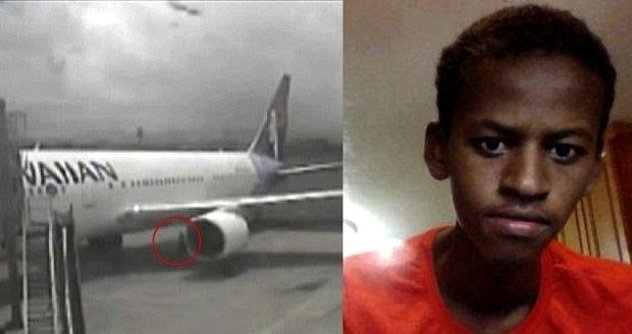
Yahya Abdi, a 15-year-old Somali immigrant, was having difficulties adjusting to his life in America. He had problems in school, and he did not get along with his new stepmother. Abdi deeply missed the home he had left with his family eight years earlier. More importantly, he missed his mother; his father had told Abdi that she was dead. Abdi was enraged when he found out his father had lied; his mother lived in a refugee camp in Ethiopia. Abdi’s father had taken the children without her knowledge.
Abdi left home. He went to an airport and snuck onto the first plane that was headed west. Abdi spent five-and-a-half hours hiding in the cramped wheel well. He lost consciousness early in the flight; however, he managed to survive the low oxygen and freezing temperatures.
When the plane arrived, he jumped down and collapsed. Abdi was disoriented, thirsty, and he could barely walk. He was hospitalized for a while, but he fully recovered. Abdi also got to speak to his mother for the first time in eight years. They both hope to be reunited with each other one day
3#Bas Wie
In 1946, Bas Wie had a dim future. He was an orphaned 12-year-old Indonesian boy, who had to work for food in the kitchens of an airport. One day he saw a plane headed for Australia, and he decided that he wanted to be on it. Wie remembered the kindness of the Australian soldiers who had given him bully beef and sweets. He hoped that Australia would be kind again.
He snuck into the wheel carriage, and he stayed there for the three-hour plane ride. It was not a pleasant journey: he was burnt by the exhaust, he had a deep cut on his shoulder, and he suffered from freezing cold blasts from the propellers. Wie spent months in the hospital recovering from his injuries.
He faced another problem once he was healed. At the time, Australia had an anti-Asian immigration policy. Many people wanted to send the boy back to Indonesia. However, he was allowed to stay in Australia to give him a better chance at life. Wie was adopted by a local family, and he became an Australian citizen twelve years later.
5#Fidel Maruhi
Fidel Maruhi wanted to change his life. He was broke, and his mother had recently died. Maruhi decided to start his life over in Paris, which he considered to be the most beautiful city in the world. Plus, Paris was home to his idol, soccer player Zinedine Zidane. Maruhi really wanted to meet him.
Unfortunately, Maruhi lived in Tahiti, which is thousands of miles away from his dream city. He knew that he would need to take a plane to Paris, and he knew that he could not afford a ticket. Maruhi decided to stowaway in the wheel well of an airplane. He managed to board the plane uneventfully, however, he fainted five minutes after the plane was airborne. He could not breathe at the high altitude.
Maruhi’s unconscious body was found in Los Angeles, where the plane had a layover. His body was covered in grease, and the wind had shredded his clothes. When he arrived at the hospital, his temperature was 79 degrees; a temperature below 85 degrees is usually fatal. Maruhi spent the night under heat lamps, and he recovered. His only lingering injury was a numbed foot.
He was sent back to Tahiti a few days later.
6#Andrei Shcherbakov
Fifteen-year-old Andrei Shcherbakov wanted to escape his family. His father drank too much, and his family often argued. Shcherbakov took a taxi and went to the airport. He saw a hole in a fence and squeezed through it. Then he walked up to a big plane, climbed up the landing gear, sat on a tire, and fell asleep.
When he woke up, the plane was in the air. He was so scared that he fainted. When the plane landed, Shcherbakov tried to climb out of the plane, but he collapsed. He could not control his legs. An ambulance hurried him to a hospital. His hands and feet were so severely frostbitten and swollen that doctors had to struggle to remove his jacket and shoes.
Unfortunately, his family could not afford the expensive treatment at the hospital in Moscow, and they had to take him back to Perm. Shcherbakov was put in a local hospital. However, his hands never recovered from the hours spent in minus 50 degree temperatures. The tissue started dying, and doctors had to amputate both of his hands.
7#Armando Socarras Ramirez
Seventeen-year-old Armando Socarras Ramirez wanted to escape Cuba in 1969. A year earlier the government had shipped him to a vocational school; however, his classes were often interrupted to plant sugarcane. Ramirez also had a constant fear of being drafted into the army. He dreamed of a better life.
He met another teen, Jorge Perez Blanco, who felt the same way. Together they plotted an escape: they planned to stow away in a wheel well of a plane headed to Madrid. They snuck into an airport and waited for their plane. The boys knew it would stop for a moment before it turned around to take off—that is when they ran for it. They scurried up the wheels and realized that they would have to separate. There was barely enough room for one in the wheel well.
Ramirez crammed himself in the tiny space; he could scarcely move when the wheels retracted. He managed to take some aspirin to dull his pain: the noise from the plane was deafening. Fortunately, he did not endure these conditions for very long—Ramirez passed out from lack of oxygen after an hour.
His frozen body fell to the ground when the plane landed, and he was brought to the hospital. Ramirez’s temperature was so low that it did not register on the thermometer. Miraculously, he recovered. Doctors said that he had only survived with “luck, luck, luck—many tons of luck.” Ramirez’s luck continued as he was allowed to move to Canada to live with relatives.
Unfortunately, Ramirez’s friend was not as lucky. Blanco was not in the airplane when it landed. He had probably fallen when the plane had lowered its wheels to land
Emilio Dominguez could not find a decent job in Honduras, and he decided that he would have better luck in the United States. Dominguez found a plane that was flying to Miami. He snuck into an airport and hid inside the plane’s wheel well. Dominguez spent more than a day hiding in there.
The flight was only two hours long. However, it must have seemed longer to Dominguez. He spent the entire flight shivering: he had only worn a short-sleeve shirt, jeans, and work boots to combat the freezing winds.
When the plane arrived, Dominguez dropped out of the wheel well and staggered away. He was spotted by mechanics, who turned him over to the police. Surprisingly, he was in good physical condition. Dominguez had no injuries and strong vital signs; he did not even need to go to the hospital. He had picked a good airplane to stowaway on. The wheel well had been somewhat pressurized, which helped him breathe easier.
Dominguez was sent back to Honduras a few days after he arrived.
8#Victor Alvarez Molina
Airline worker Victor Alvarez Molina was surprised when his wife called to warn him to leave Cuba. However, he decided to heed her warning, and he planned his escape. Molina decided to head for Montreal. He tucked himself into a wheel well of a plane and prayed for good fortune. Molina clutched a photo of his daughter and dreamed of a better life.
Molina spent four hours in the freezing, oxygen-deprived air. Fortunately, he was near a leaky heat pipe, which provided a small amount of air and heat. It was enough to sustain him. He made it to Montreal. He was exhausted, and he was suffering from hypothermia. But he was alive.
The Canadians took pity on the Cuban refugee, and they allowed him to stay. If they had sent him back to Cuba, he would have faced severe punishment: at least 15 years in prison, if not a death sentence.
Molina adapted to his new country. He found work at a car dealership, and he took French lessons. He hopes that his family will soon join him.
9#Osama R.M. Shublaq
Osama R.M. Shublaq was terrified. He had entered Malaysia on a social visit visa, and it was expiring. Shublaq did not want to return to Palestine. He had tried to seek political asylum, but it was not granted—even though Shublaq lived in a conflict-ridden area.
Shublaq decided that he should travel to a different country. He scaled the fence of a local airport and climbed into the nose wheel well of an airplane. The plane was headed to Singapore, which was only a 55-minute ride away.
The short distance saved him. Planes that travel short distances do not fly as high as planes with longer routes. The lower altitude made it easier to breathe. When the plane landed, Shublaq fell nearly eight feet to the ground. He was a bit dizzy from his journey, but he was otherwise unhurt.
Singapore sent him back to Malaysia. He faced trespassing charges, which carried a penalty of two years in prison. However, the country took pity on his situation and dropped the charges. They just sent him back to Palestine.
10#Charles McKinley
Charles McKinley was miserable. He had broken up with his girlfriend, and he was deeply in debt. McKinley wanted to go home to his parents, but he could not afford the 1,500-mile trip home. He had no money and no credit card. All he had was a UPS charge card from his job.
McKinley spotted a large wooden crate on the side of a street and had an idea: he could ship himself home. McKinley called UPS and scheduled a pickup. Before they arrived, he removed two slats of wood and squeezed himself through the hole. McKinley replaced the slats and waited.
He was picked up an hour later, and no suspicions were raised. His box was put on an airplane, and, luckily, into a pressurized hold. If he had been placed in an unpressurized hold, he would have died. McKinley spent the flight wandering around the hold. He slipped back into the box before the plane landed.
McKinley’s box was picked up from the airport, and it was brought to his family’s home. When the delivery driver started to unload the box, some of the slats fell out of the crate. The driver saw McKinley peeking through the gaps and called the police.
Although the police first feared that he was a terrorist, they soon realized that he was simply poor. McKinley pleaded guilty to a charge of misdemeanor stowaway. He was given four months of house arrest and a $1,500 fine.
 One morning in 1864, the Confederate Army woke up to 13 centimeters (5 in) of snow. The men rushed out and fought what may be one of the biggest snowball fights in history.